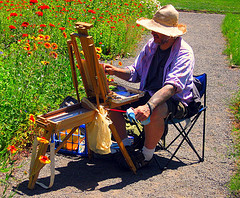
I have been doing a lot of painting outside. This is called painting in the open air or en plien-air. (En plein-air means "in the open air", in French.)
The French Impressionists such as Monet, Renoir, and Pissaro are the ones who brought painting in the open air into the forefront as a painting phenomenon.
Painting en plein-air is very new for me. Also my subject matter has changed from works of imagination and portraits to landscapes. My work is brighter now and in color and I am using oil paint and pastels.
The road to pastels has been interesting and exciting. I started down that road started when I switched, in drawing classes, from graphite to charcoal.
Charcoal, for me, was a "gateway medium".
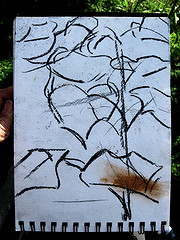
Doing landscapes in pastel began in my Intermediate Drawing class (at Lane Community College in Eugene Oregon) when we were asked to go outside and draw a landscape. I thought that I would try a sepia (reddish brick brown) and umber (dark coffee brown) colored charcoal. It just seemed more natural to use earth colors for a landscape than use black--which rarely occurs in nature.
The resulting drawing is below.
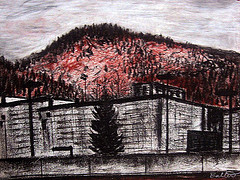 |
| My first landscape |
|
|
|
When I did this drawing I realized how much I enjoyed drawing nature from direct observation.
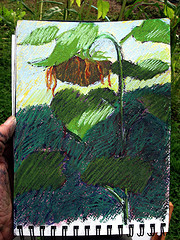
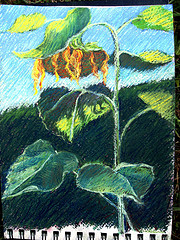
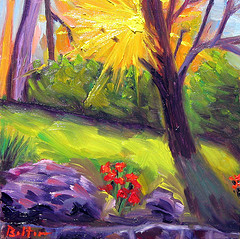
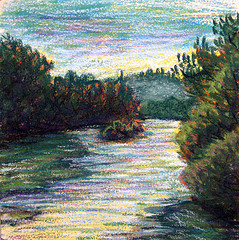
Then I watched a YouTube video in which David Hockney talked about how he was doing sunrise landscapes with a paint application on his iPhone. I loved the look of the sun and colors that he did and the next morning when I got up the sun was rising over the treetops. I didn't have an iPhone and I needed to hurry and grab something which would enable me to render the quickly rising sun; I grabbed a boxed set of Rembrandt pastels and drew the sunrise. Here is the drawing/painting:
 |
| A morning sunrise rendered with Rembrandt pastels. |
|
This was my first full color landscape--I was hooked!
There was no way I could have mixed paint in my palette and then painted the racing, rising sun. I found out later that this same sense of urgency to capture light is what caused Monet to do his "impressions".
This sense of urgency that painters feel is called "chasing the light".
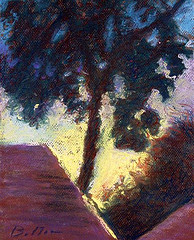
The pastel painting below was the first landscape I did where I intentionally took my pastels and went out to paint a landscape. It is of a stand of trees at a nearby golf course.
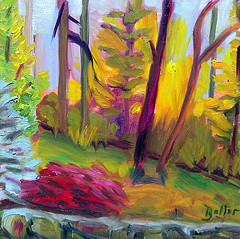
I thought I would try to paint a landscape with acrylic paint and the painting below is a painting of a tree in the Owen Rose Garden.
I am still trying to fall in love with acrylic but we have an on-again-off-again relationship. This small acrylic painting on a wooden panel just sold and will soon be in a private collection. I will miss it because I like how it makes me smile when I look at it.
I recently spent four days in the woods at my parents house. I took my pastels and drew this sunrise as the sun came up over the mountain.
I also took to their place a big book of the complete works of Vincent van Gogh. I learned in college that a way to excel as a painter is to copy the Masters--Vincent copied the masters who went before him--so, I did a few pastel copies of van Gogh paintings. Here they are:
Copying the work of beautiful and brilliant Vincent van Gogh was a real pleasure. He is one of my favorite artists. A good book about him--a biography--is called
Lust For Life. It was written by Irving Stone.
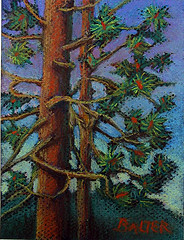
I did the pastel painting of the pine trees after I had copied Vincent's paintings and I think that his style influenced me a little. I used brighter color than I do usually. By way of illustration, compare this pine tree painting to the sunrise at my parents house, which I painted before I did the Vincent's. Can you see how I brightened my color palette?
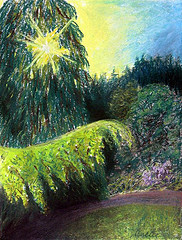
I want to end this entry with the latest pastel painting I did. I drew this one from my imagination but it is a landscape--
Hopefully, there will be many more works of art to show you--I am painting like a madman this summer!
I am excited about painting in the open air and about my discovery of pastel painting.