I realized today--as I was looking at the works of two of my Teachers, Monet and Cezanne, that I need to add more dark blue into my greens, when I want them to be darker.
Of course I knew this because on the color wheel green darkens to blue-green and then goes to blue. I knew this and yet when painting I wasn't fully utilizing the theory.
I like Monet's (an Impressionist) use of the brush--his paint handling, and his use of optical mixing such as when he puts yellow and red next to each other to make an orange. Optical mixing was one of the innovations of the Impressionists.
What I like about Cezanne ( a Post-Impressionist) is his more formal structure in his paintings--the forms help the painting hold together and not become soupy. (Monet often creates a soup--but what beautiful soup he makes!) There is an underlying strength in Cezanne's compositions. I also like how Cezanne blurs the edges of trees and rocks so that he is not creating those blasted outlines that Vincent van Gogh often used. Cezanne also softens his "outlines" by using dark blue rather than black and since blue is a cool color the edge recedes in the picture plane thus rounding the form. Cezanne is a Master of using warm colors to cause his forms to advance on the picture plane (the surface of the canvas) and cool colors to cause his forms to recede on that same picture plane.
Since I criticized Vincent's use of the black outline I will say that every painter can learn from him about the use of vibrant, complementary colors; the technique of impasto--which gives such a rich texture to a painting; and probably most important of all Vincent (a Post-Impressionist) put feeling into his works. Vincent--one of my favorite artists of all time--could make a flower look as though it was weeping or singing.
These three, Claude Monet, Paul Cezanne, and Vincent van Gogh are my current teachers. I could add Mark Rothko but that will have to wait for another day.
Of course I knew this because on the color wheel green darkens to blue-green and then goes to blue. I knew this and yet when painting I wasn't fully utilizing the theory.
I like Monet's (an Impressionist) use of the brush--his paint handling, and his use of optical mixing such as when he puts yellow and red next to each other to make an orange. Optical mixing was one of the innovations of the Impressionists.
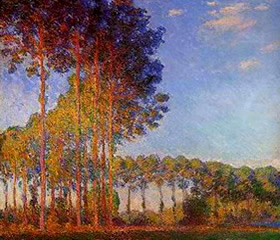 |
| In this painting by Monet we can clearly see his use of blue to create shadow and model form. |
What I like about Cezanne ( a Post-Impressionist) is his more formal structure in his paintings--the forms help the painting hold together and not become soupy. (Monet often creates a soup--but what beautiful soup he makes!) There is an underlying strength in Cezanne's compositions. I also like how Cezanne blurs the edges of trees and rocks so that he is not creating those blasted outlines that Vincent van Gogh often used. Cezanne also softens his "outlines" by using dark blue rather than black and since blue is a cool color the edge recedes in the picture plane thus rounding the form. Cezanne is a Master of using warm colors to cause his forms to advance on the picture plane (the surface of the canvas) and cool colors to cause his forms to recede on that same picture plane.
 |
| Look at Cezanne's strong composition and his use of dark blue to create shadow! |
Since I criticized Vincent's use of the black outline I will say that every painter can learn from him about the use of vibrant, complementary colors; the technique of impasto--which gives such a rich texture to a painting; and probably most important of all Vincent (a Post-Impressionist) put feeling into his works. Vincent--one of my favorite artists of all time--could make a flower look as though it was weeping or singing.
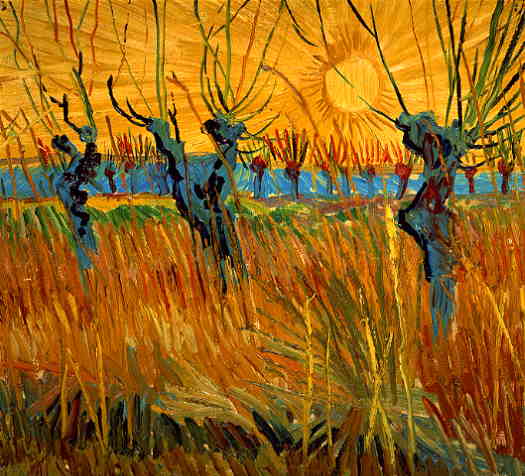 |
| Vincent van Gogh here uses a lighter, but still cool, blue to show the shadowed side of the willows and some shadow in the tall grasses at their base. |
 |
| In this painting I (Daniel Balter) used some blue in the shadowed areas of the trees but I could have used more. |
 |
| In this painting I (Daniel Balter) almost completely forgot to use blue--I am still learning! |


